
Bromelain for Lipedema: Can It Actually Help With Swelling?
If you've spent any time researching supplements for lipedema, you've probably come across bromelain.

It's frequently promoted for swelling, inflammation, bruising, and fluid buildup—all problems that immediately sound relevant to lipedema.
And unlike many trendy supplements, bromelain actually has human clinical research behind it.
But there's an important catch.
Bromelain has not yet been adequately studied specifically in women with lipedema.
So does bromelain for lipedema actually make sense?
Potentially, yes—but not because it has been proven to treat the disease.
The real reason bromelain is interesting is that research in other medical settings suggests it may influence inflammation, swelling, and pain.
And those properties make it a logical ingredient to investigate further.
1. What Exactly Is Bromelain?
Bromelain isn't technically one single substance.
It's a mixture of proteolytic enzymes found in pineapple (Ananas comosus), particularly the stem.
Proteolytic simply means the enzymes break down proteins.
But bromelain's biological activity appears to extend beyond digestion.
Researchers have investigated oral bromelain for potential effects involving:
Inflammation
Swelling
Pain
Immune signaling
Wound healing
That's why bromelain has become popular in supplements marketed toward people dealing with inflammation or tissue swelling.
But the important question isn't whether bromelain has biological activity.
It clearly does.
The question is whether those effects translate into something meaningful for lipedema.
2. Why Lipera Contains Bromelain
This is exactly why bromelain was included in Lipera.
Lipera was physician-developed specifically for women with lipedema, and bromelain isn't expected to carry the entire formula.
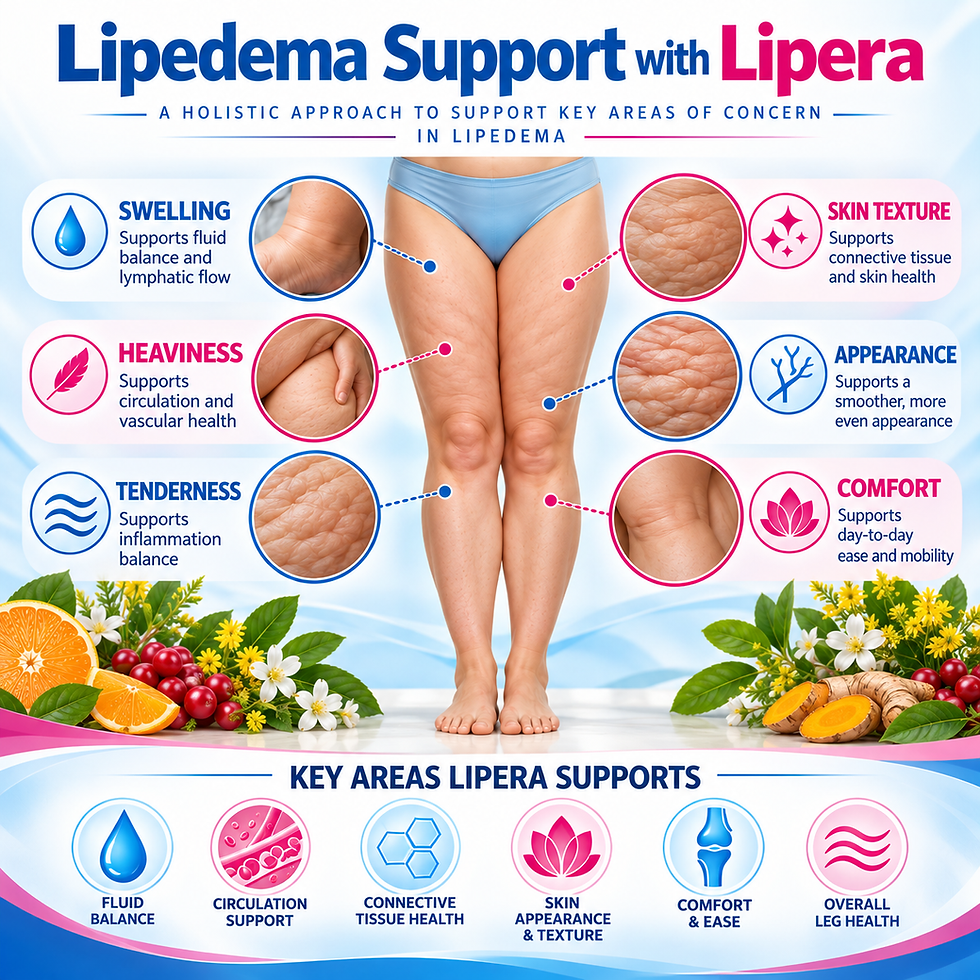
It's one component within a much broader combination.
Lipera also contains ingredients such as:
Diosmin.
Hesperidin.
Butcher's broom.
Rutin.
Quercetin.
Curcumin.
Resveratrol.
CoQ10.
And other nutrients selected around areas relevant to circulation, fluid balance, lymphatic function, and tissue health.
That's particularly important because lipedema itself appears to involve multiple biological systems.
There isn't one pathway to target.
So instead of asking one ingredient to “treat lipedema,” the goal is broader nutritional support.
Lipera hasn't been clinically proven to cure lipedema, and neither has bromelain.
But bromelain's research involving inflammation and edema provides a rational reason for its inclusion in a multi-ingredient formula designed specifically around the condition.
3. Why Are Researchers Interested in Bromelain for Lipedema?
Lipedema isn't simply excess body fat.
Affected tissue can involve pain, tenderness, easy bruising, connective-tissue abnormalities, vascular changes, inflammation, and altered fluid dynamics.
That immediately creates several potential areas where bromelain becomes interesting.
A recent review of nutritional approaches to lipedema specifically categorized bromelain as a potential edema-reducing agent.
Researchers noted its proposed fibrinolytic and immunomodulatory properties and suggested that bromelain deserves further investigation for managing edema associated with lipedema.
But they also made the limitation clear:
No specific clinical study was identified testing bromelain for this purpose in lipedema patients.
That's where the evidence currently stands.
Interesting mechanism.
Relevant broader research.
But no direct proof yet.
4. Does Bromelain Actually Reduce Swelling?
This is where bromelain has some legitimate evidence.

Several human studies have investigated bromelain following surgery, where inflammation and tissue swelling are expected.
A systematic review and meta-analysis examining patients after wisdom-tooth surgery found that bromelain was associated with reductions in pain, edema, and restricted jaw movement compared with control groups.
Another meta-analysis of six randomized controlled trials found that oral bromelain appeared to modestly decrease facial swelling after surgery.
That's important because we're talking about measurable human swelling—not simply a laboratory experiment.
However, postoperative facial swelling and lipedema are completely different conditions.
We cannot take those results and conclude:
“Bromelain reduces lipedema swelling.”
That study hasn't been done.
What we can say is that bromelain has demonstrated edema-related effects in certain human clinical settings, giving researchers a legitimate reason to investigate it further.
5. What About Inflammation?
This is probably bromelain's most famous proposed benefit.
A systematic review of randomized clinical trials examined bromelain supplementation and inflammatory markers in adults.
Seven randomized trials qualified.
Some studies reported reductions in inflammatory parameters, while others produced less convincing results.
The researchers ultimately concluded that bromelain's overall effects on inflammation were inconsistent, partly because studies involved different populations, doses, treatment durations, and biomarkers.
That's not as exciting as saying “bromelain crushes inflammation.”
But it's much more scientifically useful.
There is evidence of anti-inflammatory activity.
We simply don't know exactly how reliably that translates across different conditions—or specifically to lipedema.
6. Bromelain Isn't Going to Remove Lipedema Fat
This needs to be completely clear.
Bromelain isn't a lipedema fat burner.
It isn't going to dissolve nodules.
It isn't going to eliminate ankle cuffing.
And it isn't going to reverse established stages of the disease.
When researchers discuss bromelain and lipedema, the interesting potential benefits involve things like inflammation and edema—not removing the abnormal adipose tissue itself.
That means bromelain should never become the entire treatment strategy.
If your goal is changing your body and managing lipedema long term, nutrition, movement, muscle building, healthy body composition, and appropriate conservative care matter far more than any one enzyme.

Our guide to exercise and lipedema explains why building healthy skeletal muscle should be such a major part of that strategy.
Think foundation first.
Supplement second.
7. Could Bromelain Help With Bruising?
This is another interesting question because easy bruising is extremely common in lipedema.
Bromelain has been investigated in medical literature for postoperative bruising and swelling.
But the results aren't strong enough to say that bromelain reliably prevents bruising.
A systematic review examining bromelain and arnica after procedures found mixed results and concluded that there wasn't sufficient evidence to definitively support their use for preventing or treating post-procedure bruising and edema.
And again, lipedema bruising has its own biology.
Women with lipedema may have fragile microvasculature within affected tissue.
We don't have clinical trials showing that bromelain corrects that problem.
So don't take bromelain expecting bruises to suddenly disappear.
That's getting ahead of the evidence.
8. Why Bromelain Still Makes Sense as a Supportive Ingredient
At this point you might be wondering:
If we don't have a bromelain trial specifically for lipedema, why use it at all?
Because supplementation doesn't have to be viewed as an all-or-nothing proposition.
We know bromelain is biologically active.
We have human research involving swelling and pain.
We have research investigating its effects on inflammatory pathways.
And lipedema researchers themselves have identified bromelain as an ingredient worthy of further investigation.
That's enough to make it an interesting supportive ingredient.
It's not enough to call it a proven treatment.
Those two positions are completely compatible.
9. Bromelain Works Better as Part of a Bigger Strategy
Suppose you're dealing with heavy, uncomfortable legs.
You could take bromelain and do absolutely nothing else.
Or you could build an entire routine.
Walk regularly.
Strength train.
Maintain the healthiest body composition you reasonably can.
Use compression when appropriate.
Eat enough protein.
Build meals around nutritious foods.
Manage prolonged periods of inactivity.
Use aquatic exercise when available.
And then add targeted supplementation on top.
Which approach makes more sense?
Clearly the second.
That's also why our guide to managing lipedema swelling focuses on the broader picture rather than pretending one intervention controls everything.
Lipedema is complicated as seen in the image below.
Your strategy should reflect that.

10. Is Bromelain Safe?
Bromelain is generally considered relatively well tolerated, but that doesn't mean it's appropriate for everyone.
Clinical studies have reported side effects including gastrointestinal symptoms, nausea, flatulence, and headache.
More importantly, bromelain may not be appropriate alongside certain medications or before certain procedures because of potential interactions and effects relevant to bleeding.
That matters especially in a population already prone to easy bruising.
If you take anticoagulants, antiplatelet medications, prescription drugs, have a bleeding disorder, are pregnant or breastfeeding, or are preparing for surgery, talk with your healthcare professional before using bromelain supplements.
More isn't automatically better.
So, Does Bromelain Help Lipedema?
Bromelain is one of the more interesting supplements being discussed for lipedema—but we need to keep the evidence in perspective.
Human research suggests bromelain may have effects involving swelling, pain, and inflammatory processes in certain medical settings.
Modern lipedema reviews have specifically identified bromelain as a potential ingredient worth investigating for edema.
But there still isn't a high-quality clinical trial demonstrating that bromelain directly improves lipedema.
So don't think of it as a treatment that removes diseased tissue.
Think of it as a supportive ingredient with relevant biological and clinical evidence from other conditions.
That's also why we prefer bromelain as one component of Lipera rather than pretending it can manage an extremely complex disease by itself.
Build muscle.
Keep moving.
Eat well.
Manage excess non-lipedema body fat.
Use compression when appropriate.
And then layer targeted nutritional support on top of those fundamentals.
Bromelain isn't a cure for lipedema—but there's a legitimate scientific reason researchers are interested in what it may be able to support.