
Butcher’s Broom for Lipedema: Does It Actually Help?
Butcher’s broom sounds like something you would find in an old herbal medicine cabinet.
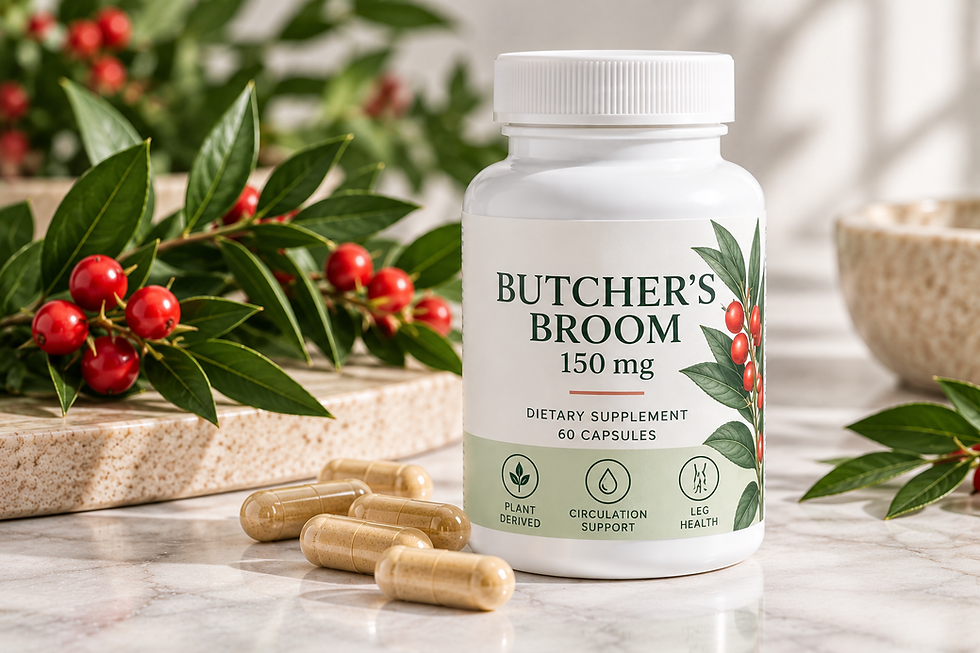
But behind the strange name is a plant with a surprisingly interesting history in vascular medicine.
Its scientific name is Ruscus aculeatus, and extracts from its underground stems have been used for conditions involving heavy legs, venous circulation, and swelling.
That naturally raises an important question for women with lipedema:
Does butcher’s broom actually help lipedema?
The answer is more interesting than a simple yes or no.
Butcher’s broom has legitimate human research supporting its use for certain symptoms of chronic venous disease, including leg heaviness, feelings of swelling, and edema.
Those symptoms overlap with problems many women with lipedema experience.
But there is currently an important limitation:
Butcher’s broom itself has not been adequately tested in randomized controlled trials specifically involving women with lipedema.
So this isn't a miracle herb.
But unlike many supplements promoted online, there is a real scientific reason researchers are interested in it.
1. What Is Butcher’s Broom?
Butcher’s broom is an evergreen shrub native to parts of Europe, North Africa, and Western Asia.
Its scientific name is Ruscus aculeatus.
The plant contains naturally occurring steroidal saponins, particularly compounds known as ruscogenins.
These compounds are believed to contribute to butcher’s broom's vascular effects.
Traditionally, extracts of the plant have been used for problems associated with venous circulation.
Modern research has investigated Ruscus extracts primarily in people with chronic venous disease or chronic venous insufficiency.
That's important.
Chronic venous disease and lipedema are not the same condition.
But symptoms such as:
Heavy legs
Swelling
Aching
Lower-leg discomfort
Fluid accumulation
can overlap.
And that's where the interest in butcher’s broom for lipedema begins.
2. What Does Butcher’s Broom Actually Do?
One of the primary areas of research surrounding butcher’s broom involves the venous system.
Your veins have the difficult job of returning blood from your legs toward your heart while working against gravity.
When venous function is impaired, pressure can increase within the lower extremities and contribute to symptoms such as swelling, heaviness, aching, and fatigue.
Butcher’s broom has traditionally been classified as a venoactive botanical.
In other words, its active compounds appear capable of influencing vascular function.
This isn't merely an herbal-medicine theory.
Clinical trials have actually tested Ruscus preparations in humans.
And some of the results are surprisingly good.
3. Why Lipera Contains Butcher’s Broom
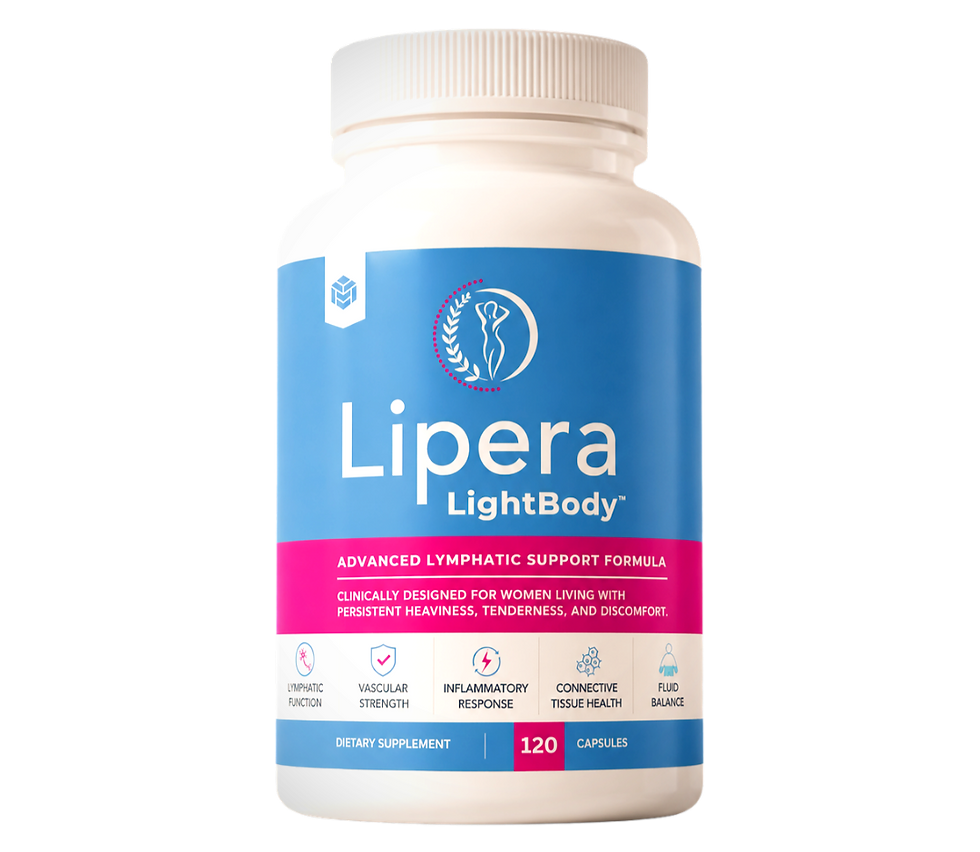
Lipera contains butcher’s broom as part of a much broader physician-developed formula designed specifically for women with lipedema.
And that's an important distinction.
Butcher’s broom isn't being asked to do everything.
It's one piece.
Lipera combines it with diosmin, hesperidin, rutin, quercetin, bromelain, curcumin, resveratrol, CoQ10, and other ingredients selected around areas relevant to lipedema management.
The idea is broader support involving areas such as:
Circulation.
Fluid balance.
Lymphatic function.
Tissue health.
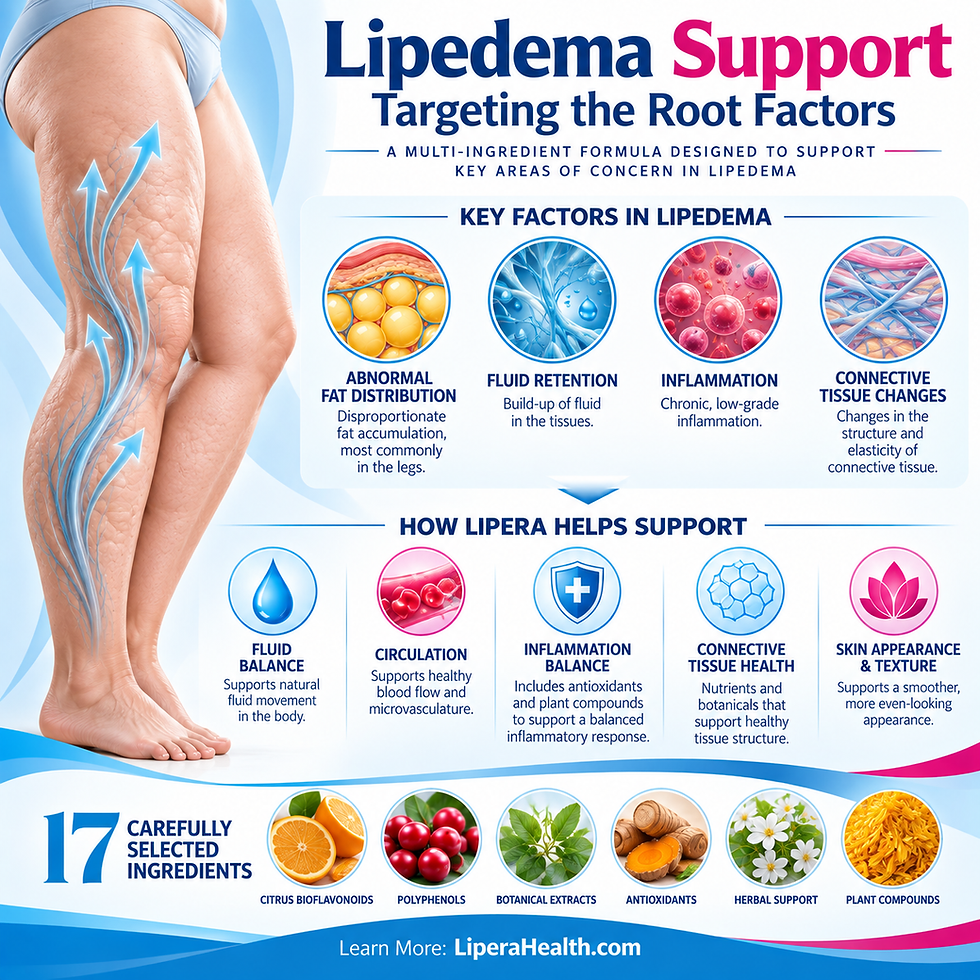
That's very different from purchasing a bottle of butcher’s broom and expecting one herb to somehow treat an extremely complicated tissue disorder.
Lipera itself has not been clinically proven to cure lipedema.
And butcher’s broom has not been proven in lipedema-specific randomized controlled trials.
But there's a legitimate rationale behind including the ingredient.
Its human research on venous symptoms and edema is exactly why it makes sense as one component of a broader support formula.
3. The Human Research on Leg Swelling Is Interesting
A systematic review and meta-analysis examined randomized, double-blind, placebo-controlled trials involving Ruscus extracts in people with chronic venous disease.
Researchers identified 10 trials involving 719 patients.
Compared with placebo, Ruscus-containing treatment improved several symptoms, including:
Leg pain
Heaviness
Fatigue
Feeling of swelling
Cramps
Itching
Paresthesia
But perhaps the most interesting finding for women researching lipedema was what happened to measurable edema.
Researchers found reductions in ankle circumference and leg or foot volume compared with placebo.
The systematic review of Ruscus concluded that the evidence supported reductions in symptoms and edema among patients with chronic venous disease.
That's meaningful evidence.
But there's a critical sentence we need to add:
Those patients had chronic venous disease—not lipedema.
We cannot automatically assume the exact same results occur in lipedema.
4. Why Could This Matter for Lipedema?
Lipedema isn't simply excess body fat.
It involves abnormal adipose and loose connective tissue and can be associated with pain, tenderness, easy bruising, heaviness, vascular changes, and altered fluid dynamics.
Many women describe their legs as:
Heavy.
Full.
Pressurized.
Swollen.
Achy.

Those symptoms are part of the reason researchers have become interested in compounds that affect vascular function and edema.
Butcher’s broom isn't expected to remove lipedema fat.
That's not its proposed purpose.
The more plausible interest involves supporting venous circulation and fluid-related symptoms.
And newer lipedema literature has noticed the ingredient too.
5. Is Butcher’s Broom Actually Recommended for Lipedema?
Here's where we need to separate promising biology from proven treatment.
A recent comprehensive review of lipedema specifically lists butcher’s broom among supplements that have been proposed based on their mechanisms of action.
That sounds encouraging.
But the researchers immediately point out the limitation:
These supplements have not been rigorously studied in randomized controlled trials specifically for lipedema.
That's the current state of the science.
So if someone tells you:
That's too strong.
But saying:
That's much more defensible.
And it's still pretty compelling.
6. Butcher’s Broom Isn't a Fat Burner
This needs to be crystal clear.
Taking butcher’s broom isn't going to melt lipedema fat.
It isn't going to turn Stage 3 lipedema into Stage 1.
It isn't going to eliminate nodules.
And it isn't going to replace exercise, nutrition, compression, or appropriate medical care.
Its potential role is completely different.
Think:
Circulatory support.
Venous function.
Fluid-related support.
Heavy-leg symptoms.
Those are the areas where the ingredient's broader research becomes interesting.
This is also why focusing on one herb as “the treatment” misses the bigger picture.
Lipedema involves far more than one pathway.
7. What About Swelling?
This is probably the most interesting potential benefit.
One randomized, placebo-controlled study included 166 women with chronic venous insufficiency and evaluated butcher’s broom extract over 12 weeks.
Researchers measured leg volume, ankle circumference, lower-leg circumference, and symptoms.
The Ruscus group experienced improvements in several objective measurements compared with placebo, including leg volume and circumference.
Again:
Chronic venous insufficiency is not lipedema.
But this gives us something much more meaningful than a supplement company simply saying butcher’s broom “supports drainage.”
There's actual human evidence that preparations containing or based on Ruscus can affect edema-related outcomes in another lower-extremity vascular condition.
That's why the ingredient deserves attention.
8. But Lipedema Swelling Is More Complicated

Here's the problem.
When a woman with lipedema says:
“My legs are swollen.”
Several different things could be contributing to that sensation or appearance.
There is the abnormal adipose tissue itself.
There may be increased interstitial fluid.
There may be venous issues.
There may be lymphatic dysfunction.
Some women can eventually develop secondary lymphedema.
Inflammation and connective-tissue changes may also contribute to how the tissue feels.
So reducing the entire problem to “water retention” is inaccurate.
And that means no single diuretic herb or vascular supplement is going to solve everything.
This is why we've previously emphasized comprehensive lipedema management rather than chasing one treatment at a time.
The more complex the disease, the more important the overall strategy becomes.
9. Butcher’s Broom vs Diosmin
This is where things get particularly interesting.
Butcher’s broom isn't the only plant-derived compound studied for venous health.
Diosmin has an even stronger connection to lipedema management.
The U.S. Standard of Care specifically states that diosmin may be considered for lipedema tissue and describes it as having lymphagogue properties along with effects relevant to edema and the microcirculation.
Butcher’s broom has separate evidence from chronic venous disease research.
So instead of asking:
“Which single herb should I take?”
A more interesting question becomes:
Could multiple ingredients targeting related pathways make more sense together?
That's exactly where formulation starts mattering.
11. Why We Prefer the Multi-Ingredient Approach
Look at everything researchers are investigating in lipedema.
Adipose tissue.
Connective tissue.
Extracellular matrix.
Blood vessels.
Interstitial fluid.
Inflammation.
Fibrosis.
Lymphatic function.
Hormones.
Genetics.
That's a lot of biology.
It would be strange to assume one botanical compound is going to address all of it.
Instead, think of supplementation as one layer within a broader routine.
Nutrition provides the foundation.
Resistance training builds healthy skeletal muscle.
Walking and cardiovascular activity keep the body moving.
Compression can help manage symptoms for appropriate patients.
Maintaining a healthy body composition reduces unnecessary mechanical and metabolic burden.
And targeted supplementation can provide additional nutritional support.
That's much more realistic than searching for the one perfect herb.
12. Can Butcher’s Broom Help With Heavy Legs?
Potentially—and this is actually where the evidence is strongest.
“Heavy legs” is one of the symptoms repeatedly studied in chronic venous disease trials involving Ruscus.
A large earlier meta-analysis examined clinical studies involving a combination of Ruscus aculeatus, hesperidin methyl chalcone, and vitamin C.
Across the studies, treatment was associated with improvements in symptoms including
heaviness, pain, cramps, and paresthesia.
That doesn't establish the same effect in women whose heavy legs are specifically caused by lipedema.
But it does give us a biologically relevant reason for interest.
If your legs feel extremely heavy because of lipedema, don't assume butcher’s broom is guaranteed to fix that sensation.
But its history of use for heavy-leg symptoms isn't based purely on folklore.
There is clinical research behind it.
13. What Else Should You Do for Heavy, Swollen Lipedema Legs?
Don't put all the responsibility on a capsule.
Move.
Your muscles are powerful mechanical contributors to normal circulation and fluid movement.
Walk regularly.
Build your calves.
Build your thighs.
Strengthen your glutes.
If you have access to a pool, aquatic exercise can be particularly useful because you're combining muscular movement with external hydrostatic pressure.
Compression can also be helpful for pain, heaviness, and edema when properly fitted and appropriate for the individual.
We've gone deeper into one of the best low-impact options in our guide to swimming for lipedema.
Then layer supportive tools on top of those fundamentals.
Don't replace the fundamentals with supplements.

14. Is Butcher’s Broom Safe?
“Natural” doesn't automatically mean appropriate for everyone.
Butcher’s broom preparations have generally been well tolerated in clinical studies, but supplements can still cause adverse effects or interact with medications.
And the safety of a particular product depends on far more than the ingredient name on the front of the bottle.
Dose matters.
Extract standardization matters.
Other ingredients matter.
Your medications matter.
Your medical conditions matter.
Pregnancy and breastfeeding matter.
If you take prescription medications or have cardiovascular, kidney, blood-pressure, or other significant medical conditions, discuss supplementation with an appropriate healthcare professional.
The goal isn't simply taking as many “circulation supplements” as possible.
It's using them intelligently.
So, Does Butcher’s Broom Help Lipedema?
The answer is:
Potentially useful as a supportive ingredient—but not proven as a lipedema treatment.
Butcher’s broom has legitimate human clinical evidence involving chronic venous disease.
Research has associated Ruscus preparations with improvements in leg heaviness, feelings of swelling, pain, and objectively measured edema.
That's substantially more evidence than exists for many trendy supplements promoted to women with lipedema.
But we still have an important gap.
The research wasn't conducted specifically in women with lipedema.
Newer lipedema reviews acknowledge butcher’s broom as a proposed supplement while emphasizing that it has not yet been rigorously tested in lipedema-specific randomized trials.
So don't expect one herb to remove lipedema tissue.
Instead, use the evidence for what it actually tells us.
Butcher’s broom is an interesting vascular-support ingredient with human evidence relevant to symptoms that overlap with lipedema.
That's also why we prefer it as part of a broader strategy rather than as a standalone miracle treatment.
Build muscle.
Move regularly.
Eat well.
Use compression when appropriate.
Maintain the healthiest body composition you realistically can.
And if you choose supplementation, look for ingredients selected around the actual biological challenges you're trying to support.
Butcher’s broom isn't a cure for lipedema.
But there is a legitimate scientific reason it earned a place in Lipera's formula.