
Stage 3 Lipedema Life Expectancy: Does Lipedema Actually Shorten Your Life?
Reaching an advanced stage of lipedema can be frightening.

When mobility becomes harder, tissue changes become more visible, and swelling or pain interferes with everyday life, it's understandable to wonder whether the condition is affecting more than your quality of life.
The reassuring answer is that there is currently no good evidence showing that Stage 3 lipedema itself automatically shortens a person's lifespan.
That distinction matters when discussing stage 3 lipedema life expectancy.
Stage 3 can be physically serious and deserves proper management, but having advanced lipedema is not the same thing as being diagnosed with a terminal or inherently life-shortening disease.
According to the Cleveland Clinic lipedema overview, the condition may worsen over time in some people while remaining relatively mild in others, and treatment can help manage symptoms and complications.
1. What Does Stage 3 Lipedema Actually Mean?
Stage 3 describes the physical characteristics of the affected tissue—not how many years someone has left to live.
At this stage, the disproportionate accumulation of tissue is usually much more pronounced than in stages 1 or 2.
Large folds or lobules of tissue can develop, particularly around the thighs and knees.
The underlying tissue may also become considerably more nodular and fibrotic.
In severe cases, these changes can interfere with walking and everyday movement.
This is one reason stage 3 lipedema symptoms can feel dramatically different from earlier disease.
Pain, heaviness, mobility limitations, tissue enlargement, and swelling may have a much greater impact on someone's daily life.
However, stage number should not be interpreted like cancer staging. Stage 3 does not mean the disease has spread throughout the body or become terminal.
2. Does Stage 3 Lipedema Shorten Your Life?
There is currently no established number of years that someone with Stage 3 lipedema is expected to lose.

In fact, there isn't a scientifically established lipedema life expectancy that doctors can use in the way they can for certain progressive or life-threatening diseases.
Researchers studying lipedema have focused much more heavily on symptoms, mobility, cardiovascular and metabolic characteristics, psychological health, disease progression, and quality of life than mortality.
That doesn't mean advanced disease should be ignored.
Instead, the important question becomes whether complications or other medical conditions occurring alongside lipedema could affect long-term health.
Research into advanced lipedema characteristics describes the substantial mobility limitations and quality-of-life burden that can occur in severe disease.
That is serious—but it is very different from saying Stage 3 itself determines lifespan.
3. The Bigger Health Concern May Be What Happens Around Lipedema
This is probably the most important distinction in this entire discussion.
Lipedema and the health conditions that can coexist with lipedema are not necessarily the same thing.
For example, someone with severe stage 3 lipedema legs may become increasingly sedentary because walking hurts.
Reduced activity can then make maintaining cardiovascular fitness, muscle strength, joint health, and overall metabolic health more difficult.
Obesity may also coexist with lipedema, but the two conditions should not be treated as interchangeable.
Research suggests women with lipedema can have a different metabolic profile from women with conventional obesity.
This means looking at someone's BMI alone may give an incomplete picture of her overall health.
The better approach is to assess the whole person: blood pressure, glucose control, cholesterol, abdominal fat distribution, mobility, cardiovascular health, strength, fitness, and other individual risk factors.
Maintaining movement can therefore become especially important as disease advances.
Even low-impact activities can help preserve function, and swimming for lipedema can be particularly useful because the water reduces joint loading while providing external pressure around the limbs.
4. What Happens When Stage 3 Lipedema Progresses?
Does stage 3 lipedema get worse? It can, although progression varies significantly between individuals.
Stage 3 is characterized by pronounced changes in the architecture and distribution of the affected tissue.
Large lobules may develop around the knees, thighs, hips, or other affected regions, and mobility can become increasingly difficult.
Lymphedema can also coexist with lipedema.
This combination is often called lipolymphedema.
Importantly, modern approaches increasingly distinguish secondary lymphedema from the physical staging of lipedema itself rather than assuming every person with Stage 3 will inevitably develop it.

The U.S. lipedema standard of care describes Stage 3 as involving increased, more fibrotic lipedema tissue with numerous large subdermal nodules and overhanging lobules.
This matters because worsening swelling shouldn't automatically be dismissed as “just my Stage 3.”
New or changing symptoms deserve evaluation.
5. Can You Go From Stage 3 Lipedema Back to Stage 2?
This is where there is reason to be optimistic—but also where expectations need to be realistic.
Technically, diet, exercise, and supplements cannot be guaranteed to change someone's clinical classification from Stage 3 back to Stage 2.
Stage 3 involves structural changes in lipedema tissue, including fibrosis, nodules, and larger lobules that may remain even after substantial changes in overall body weight.
But that does not mean your body cannot change significantly.
One of the biggest opportunities is improving body composition.
Lipedema primarily involves adipose and connective tissue rather than skeletal muscle.
That means the muscles of the legs can still be strengthened even when the surrounding fat is affected by lipedema.
Building muscle while reducing excess non-lipedema body fat can make a meaningful difference.
Stronger legs can improve mobility and physical function, while reducing excess body weight can decrease the total load placed on the knees, hips, ankles, and cardiovascular system.
Instead of trying to starve away lipedema tissue, focus on the parts of your body composition that can respond.
Resistance training can build and preserve muscle.
Walking, cycling, swimming, and other tolerable forms of movement can improve conditioning and keep the muscles working.
A sustainable eating pattern can help reduce excess non-lipedema fat when it is present.
And those changes matter even if some lipedema tissue remains.
Nutritional support can also form part of a broader management routine.
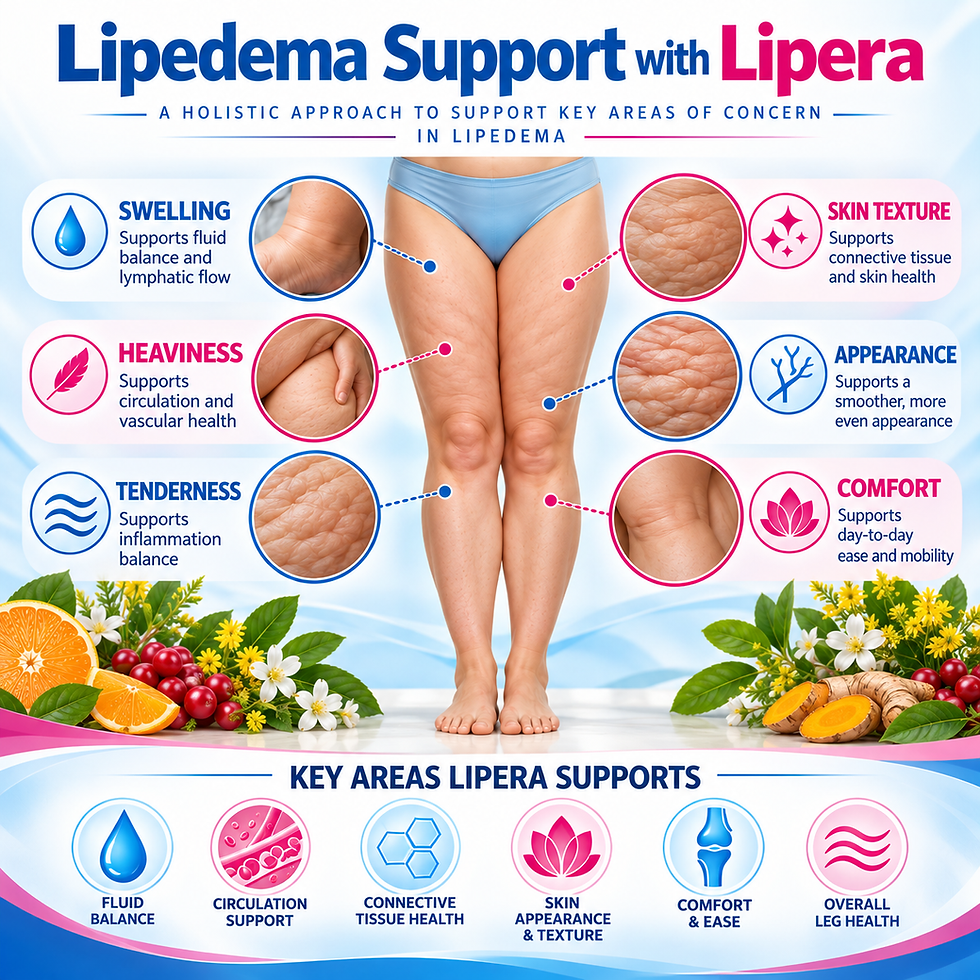
Lipera's lipedema support formula was physician-developed with ingredients selected to support areas relevant to women with lipedema, including lymphatic function, circulation, fluid balance, and tissue health.
The important takeaway is that Stage 3 does not mean you have lost the ability to improve your body.
A woman with advanced disease may become leaner, stronger, more mobile, less burdened by excess weight, and dramatically more functional without technically changing her lipedema stage.
So don't become obsessed with turning a “3” into a “2.”
A much better goal is making Stage 3 affect your life as little as possible.
6. Can You Live a Normal Life With Stage 3 Lipedema?
Yes—but “normal” may require adaptations.
Living with stage 3 lipedema can involve challenges that someone with mild disease never experiences. Standing for long periods may become difficult. Walking distances may decrease.
Finding clothing can become frustrating. Joint discomfort and heaviness can interfere with work, exercise, travel, and social activities.
But Stage 3 does not mean improvement is impossible.
Management is generally aimed at controlling symptoms, preserving mobility, reducing pain, managing swelling, and preventing secondary problems.
Depending on the individual, that may involve compression garments, appropriate physical activity, weight management when excess non-lipedema fat is also present, manual lymphatic drainage when indicated, physical therapy, pain management, treatment of associated lymphedema, and lipedema reduction surgery in appropriately selected patients.
Women who are concerned that their disease is continuing to advance may also find our guide to how lipedema progresses with age useful for understanding factors that can influence symptoms over time.
7. What About Heart Disease and Metabolic Health?
This area is more complicated than many articles make it sound.
It would be incorrect to say that lipedema has absolutely no relationship with cardiovascular health—but it would also be incorrect to assume that a large lower body automatically means someone has the same cardiovascular risk associated with conventional obesity.
Research has suggested that women with lipedema can retain relatively favorable metabolic characteristics compared with BMI-matched women with conventional obesity.
At the same time, coexisting obesity and other conventional cardiovascular risk factors still matter.
The cardiovascular lipedema research emphasizes evaluating actual cardiovascular risk factors and body-fat distribution rather than assuming BMI tells the entire story.
That means your individual health markers matter.
Blood pressure matters. Blood sugar matters.
Cholesterol matters. Cardiovascular fitness matters. Visceral fat matters. Your ability to remain active matters.

And this is another reason building muscle and preserving mobility become so valuable in advanced disease.
Exercise isn't only about making the legs smaller. It's about protecting the rest of your body for the long term.
8. What Stage 3 Lipedema Really Means for Your Future
A diagnosis of Stage 3 can sound much scarier than what the stage actually represents.
It tells clinicians that substantial structural changes have occurred in the affected tissue.
It can also signal greater problems with mobility, pain, functional impairment, and secondary complications that deserve attention.
But it is not a countdown.
There is currently no established evidence that stage 3 lipedema life expectancy is inherently shorter simply because someone has reached Stage 3.
And advanced disease doesn't mean there is nothing left to improve.
You can work on strength. You can preserve muscle. You can improve cardiovascular fitness.
You can address excess non-lipedema fat when present. You can manage swelling and protect your joints.
You can build a sustainable routine around nutrition, movement, compression, and other appropriate treatments.
The number attached to your stage is ultimately less important than what your body is capable of doing.
Stage 3 deserves to be taken seriously, but it does not define your future.
The goal is to preserve as much movement, independence, comfort, strength, and quality of life as possible—and there may still be a great deal you can improve.